Showing posts with label Heritage. Show all posts

Sunday, 21 June 2015

Father's Day


This morning I sat  on the pavement outside the North gate of the Madras High Court and decided to sketch Anderson Church. I've passed by it so many times and never sat down to do a sketch until now. I love the proportion of it's spire.

The really interesting thing is this Church sits bang on Broadway and is crowded in on all sides by hectic business activity jostling for space. Although it was a Sunday morning I wanted to try and bring that in somehow.

Some of the other sketchers in our group were attending a heritage walk inside that I had been to and sketched over a year ago. My father decided to sketch the same church too and we found ourselves side by side on the pavement. Me on the ground and him on a stool.

It was really amazing that for over an hour an endless stream of people, mostly the security guards of the high court, would come up and talk to me and look at the work, ask questions. But no one disturbed my father at all!!

As I finished up my sketch I realised its father's day! I don't as a rule follow valentines and father's and mother's day. Can't wrap my head around assigning days to random things, but found the coincidence surprising. So I wrapped up with a quick sketch of my dad to remember the day better.


His sketch turned out really well too!

Sunday, 14 June 2015

Quick trip to Kodaikanal


This week I had to go to Kodaikanal on work. I considered myself lucky. Its not everyday that you get to legitimately leave 42 degrees C and climb into the hills. Kodai was a lovely 19 and my work was done with a couple of hours to go for sunset.

Although for most tourists the highlight of a trip to Kodai would be a boat ride on the lake, I myself prefer walking along the quieter non-touristy parts of the hill-station. This is a view of the boat houses from across the lake. In an attempt to keep the water clean the municipality have fenced off the lake from the pavement. I snuck in through a small opening and sat on a low wall. My feet hung down over some reeds and dense plants. 
Halfway through I was juggling my staedtler 0.7 liner into my bag and trying to get my watercolours out and down went the 0.7! Boo hoo, not only did I lose a pen but I also polluted the poor lake!

Another highlight for me when I visit Kodai in summer is the fruits! We all rave about the mangoes (and they truly are the world's best fruit) but summer in Madras also means plums and peaches from the hills. I took a walk to the fruit stalls to buy some plums and realised there are a whole range of summer fruits up on offer!

Plums, tree tomatoes, egg fruits (so called because the soft sweet flesh is the colour of a golden yolk) grapefruit, passion fruit, star fruit, avocado, pears, fresh badam, chikoo, and of course banana pineapple and apple. I first bought some plums from the shop on the right. He made me taste a half-dozen other fruit and I promised to be back the next day to buy more stuff. Then I walked across to the pavement opposite the shops and started my sketch.


Halfway through my sketch a passer-by alerted the shopkeeper that he was featuring in my drawing. He came and looked at it and was very pleased. Soon the next door shop guy came out to take a look. Then others were summoned. Finally the shop owners wife was called out. Someone shouted "Come and see how she's drawn your husband!"A smiling shy muslim lady came bustling out of the shop, took the book from me and exclaimed in surprise. Then she smiled and ran back inside. Someone else joked that I had passed the test.

The next day I only managed a quick watercolour of John enjoying his morning coffee and book. We were very lucky with the weather. It stayed clear throughout the time that we were out.
Just before leaving I went as promised back to the fruit shop to buy more fruit to take back to Madras. The wife recognised me and gave me a really good deal! Three cheers to sketching!

Monday, 1 June 2015

Children's Garden School


The Children's Garden School is just a short hop from my house. It was started in 1937 by Mr V.N Sharma and his wife Ellen, with just seven children as students. It was one of the early schools that tried to change regular mainstream education from a classroom format to a play-and-learn kindergarten format.

Over the years, just like everything else it has grown . There are over 3000 students now, its a girls' school with a separate creche, a junior school and a senior school. All available land has been built over to make space for more classrooms and facilities but this old building where the Prinicipal lives is the original building. It reads "1919-20"  at the very top.

In the early fifties my mother too went to this school, to the junior section. I've heard many stories from her  reminiscing about the classes under the trees and in this building.

I sat on the pavement opposite the main gate on Sunday evening and not a soul passed me by as I did this sketch. It was the last sunday before the end of summer vacation. This morning, as I left home for office the entire street was transformed with hundreds of kids, cycles, parents and general mayhem.


Monday, 4 May 2015

Three generations sketching together


My eleven-year old niece Anya is an aspiring artist and always has many colourful and interesting projects to show us each time we visit. For almost a year now, we've been planning and meaning to go out sketching together and it finally happened this Sunday. Along with my parents, this meant we were three generations sketching on location. Pretty cool!

Since the heat is unbearable we chose an indoor air-conditioned spot - House #22 Cafe is a restored old Portuguese style Bungalow near St. Thomas Mount. We started out being the only customers and grabbed a large table in the corner with a great view of the room and the garden outside. We ordered some food but it lay untouched as we all got straight into it. As you can see my mother didn't even bother sitting down!

Before we knew it a couple of hours had flown by. As we wrapped up Anya and I decided to sketch each other quickly. She did a pretty good one of me. Maybe she'll blog it...?


Thursday, 15 May 2014

Madras High Court Heritage Walk


On Sunday morning bright and early at 8 am a large group of us gathered near the old Light house within the Madras High Court campus. The event was a heritage walk cum talk organised by Intach and the gathering of over 50 people were mostly architects, history enthusiasts, journalists or Intach members. The talk started off at the base of the Light house. Built in 1834 and faced with beautifully dressed granite it is in the shape of a large fluted doric column. It has a spiral stairway inside and a pile of firewood was lit each night at the top as a signal to approaching ships.

I was under the impression that we would walk through the building and then there would be a talk later in a hall. That's what I had understood from the invite but as it happened there were short talks about specific parts of the campus and its history right through the walk which lasted 2 hours in total. So right from the start I kept getting five minutes here and there and sneaked in these quick sketches.
From the Lighthouse we walked along the Eastern side of the main building. Sujatha Shankar, a senior Architect and Convener of Intach Chennai took over the talk at this point and started talking about the detailing and the style. The happy marriage of brick and granite that forms the building language.

The High court building took many years to build and doubtless many people contributed. But it's design is mainly credited to Henry Irwin and she spoke about how he was deeply influenced by previous works by Robert Chisholm (in fact just along the beach at the Chepauk Palace and Senate House). The High Court is generally acclaimed as one of the best examples of Indo Saracenic Architecture and we went up close to an arched opening on the east face where she enumerated the many ways in which it was a confluence of various styles.

We then moved into the East Portico. The building has entrances in all 4 cardinal directions but the East gate is currently kept locked up. Mr. Rajah, an Advocate with the high Court and part of the High Court heritage committee took over talking about the history of some incidents at each of the locations we had passed. The gate itself, which I tried to capture as a background in this sketch was beautiful 3 dimensional wrought iron work. But since we couldn't get into the building from here we walked around to the North Portico.

Along the way, we stopped at this statue of Sir Bhashyam Iyengar who was the first Indian acting Advocate General. Mr Rajah pointed out interesting trivia like the fact that the correct formal attire for an Indian like Mr Iyengar was - Silk turban, Robes, Panchakacham (dhoti) and shoes and so this is how he is portrayed in his statue

Our first stop inside the building was the High Court Museum. It has a vast collection of documents, plaques, various objects and furniture used long ago in the courts and this room at the back that is set up with the original furniture. I could only get a peek in and then we were off to the Madras Bar association Library.

Once again Mr Rajah regaled us with many historic tales and anecdotes to try and give us a picture of what it meant in those days to be a member of the Bar, the kind of people they were. Some tales of abject corruption but equally as many of high integrity and honour.

Finally we were also shown the Chief Justice Hall, a very ornate courtroom and with so many of us inside I decided to try and sketch the ceiling as I couldn;t quite look across the hall. The first chief justice was Sir Thomas Lumisden Strange, apparently a great man who was incorruptible and highly regarded,  and a huge portrait of him hangs on the wall facing the Judges, supposedly reminding them of what they need to live up to.
The ceiling itself had a geometric pattern of wooden frames holding up a cardboard painted false ceiling that looked rich and ornate. The same kind of 4-8-16 geometries were seen in a lot of the Jali work and metal work all over the building.
Intach plans on holding this walk and opening it out to all citizens every 2nd Sunday of the month. I would highly recommend it!
And on a final note - I finished another sketchbook! That's the second one to get over this weekend.

Sunday, 16 February 2014

Lots of CWA action!


2014 has started out with lots of sketching action and oppurtunity for me. Most of it is thanks to the CWA. A wonderful group that I am a part of that makes sure that no matter what happens there's a reason to sketch outdoors each sunday. Soon after I was back from Goa, our group displayed our sketches during the Mylapore fest and next to our stall was a busy street full of banana vendors. Below you see the general crowd and mayhem of Art Street where we camped with our artwork, making live portraits and sketches.
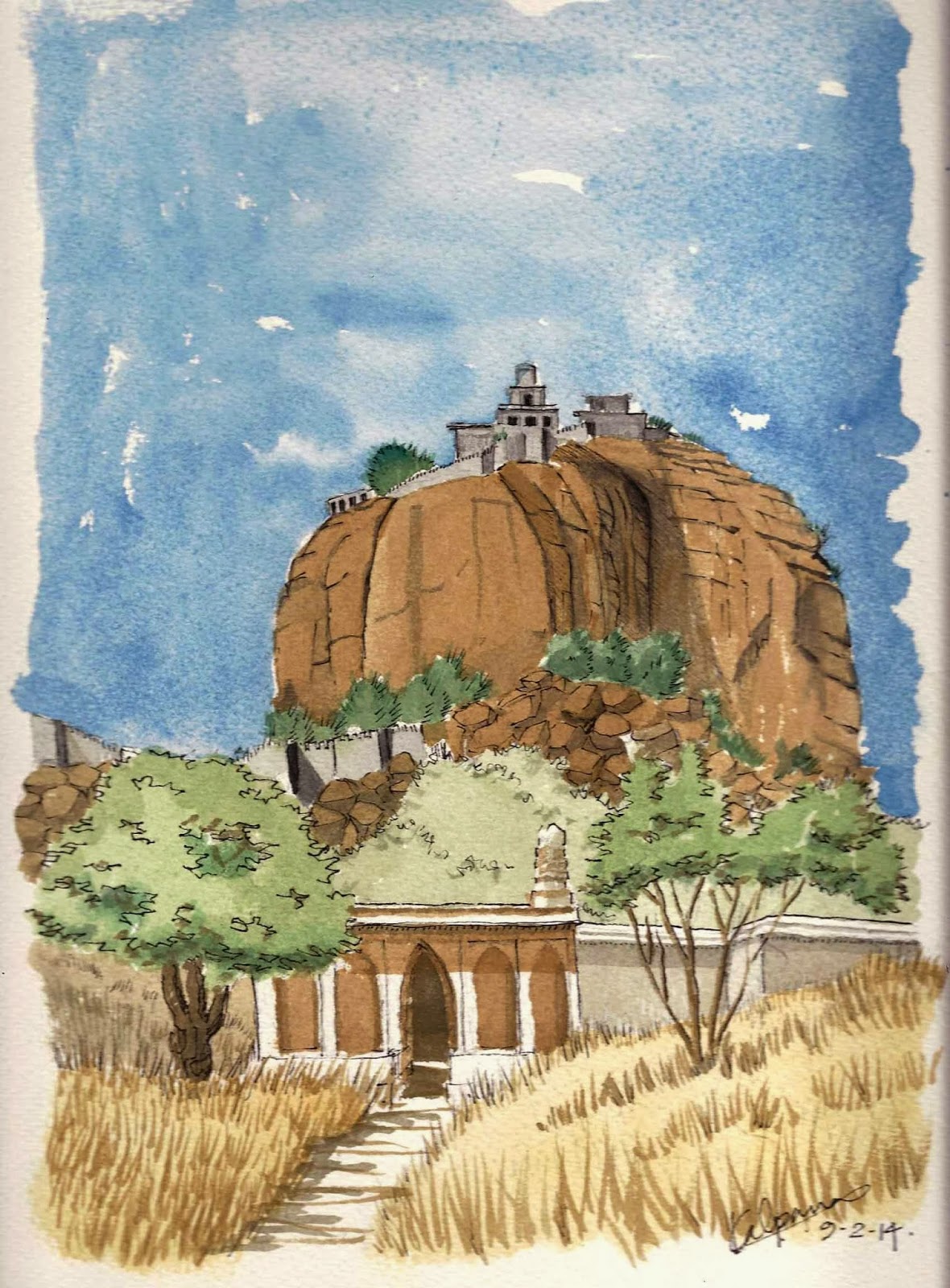
More recently, we took a day trip to Senji which was hot, tiring but totally worth it. The old fort and the ruins have tons of sketchworthy subjects to offer. My first painting is of Rajagiri or King's Fort. I tried to do a watercolour directly without doing outlines in pen. Something I'm very afraid of and in the end I succumbed and added a bit of ink work for definition . But at least its a start. At least I did the brushwork first.
And this one below is an attempt at a panoramic capture of Senji. I climbed up Rajagiri (my first painting) but only a fifth of the way and already the view was so... Epic... as a friend put it, that I gave up on the climb and decided to record instead.
Those monkeys crept into the frame. Look adorable. Most annoying and when they single you out (one female did) it can be quite terrifying.

Friday, 14 February 2014

Houses of Goa


Towards the end of my week in Goa, I visited this place in the sketch above. Known as Houses of Goa it is a 3 storey museum of ...well.... houses, in Goa. Some of the very wealthy mansions as well as the typical village houses are documented through measure drawings and photographs and presented with a lot of detailed and descriptive writing about the lifestyle. I was also happy to see sketches and paintings of the houses done more recently added in as part of the collection on view.

Apart from plans and models, the collection also includes sign boards, architectural detail elements,  ornamental pieces and all kinds of household articles that are a reminder of a past lifestyle. Goan architecture is heavily portugese influenced and this is evident in the smallest of details.
 I tried to capture some of them, the ones that caught my eye the most. After wandering slowly through the 3 floors I came back out and sketched the building when a tall gentleman passing by on the road came up to me and asked if I wouldn't mind if he watched while I sketch. I said I wouldn't and he stood behind me for some time. It was only as he left and entered his house next door that I realised it was Gerard DaCunha, the architect of the Museum!


Houses of Goa is an island surrounded by road and on one side, Gerard's house faces the museum. On the other is Gerard's office - his architectural practice. The office also houses the official Mario Miranda Gallery. So after the sketching was over that's where I went next. I'm a huge fan of Miranda's work and was so absorbed in studying his sketches that I didnt produce any of my own in the gallery.

Monday, 3 February 2014

Approaching the Koothambalam


I chanced upon the Koothambalam while walking through Kalakshetra campus from the other side. Approaching from the office and going past the newly built lotus pond area I followed a group of dance students as they walked purposefully towards their practice cottages. So as not to disturb them while they rehearse, I turned away and was suddenly stopped in my tracks by this scene. The majestic structure loomed out from amidst the trees. I had approached it from the back.
With my usual fascination for performance spaces I began sketching, standing up. The Koothambalam is undergoing extensive renovation and the main entrance area is quite un-approachable at the moment. They are planning to air-condition the space and the inside of the  auditorium was covered in scaffolding.

As I sketched I thought of groups and repertories with their own performance spaces. How important it is. As vital as the work itself. I thought of the koothambalam as an inspiration for the young students who would work towards performing there and then, as I stood, in the shadow of the old trees, sketching from "behind the scenes" , I thought of a weekend, a few years ago when we had staged two plays inside the same space. I remembered carrying the set through those large doors and the frenetic activity ahead of the shows. Its funny how the sketch turned into such a nostalgic experience.

Monday, 20 January 2014

The Church of Our Lady of Light


Lets skip a bit back to Madras. After so recently sketching the Sao Sebastian Chapel in Panjim, I suddenly thought to myself that the Luz Church is literally one minute away from my office and I have never visited. So there I headed yesterday morning. It's the oldest surviving church structure in Madras and has 1516 proudly embossed over its main doorway.
Sunday mass was under way so I chose to sketch from outside. Once the mass was over I was soon surrounded by a gang of young girls. They were very eager and enthusiastic to watch me sketch and chattered away non-stop to each other. They spoke in Tamil, which of course, is my mother tongue and I could understand everything they said, including the fact that they assumed I didn't know Tamil.
Here's a few interesting snippets of conversation that I enjoyed: (everything was being said in Tamil)

"Hey, look! She's drawing with her left hand!"
"Yes, see. That is why that tree which is on the left of the church is coming on the right side of her drawing."
" Hey, do you think she will show us the rest of the sketches in her book? I really want to see the rest of the sketches. You ask her. My english is not good."
" No! You ask Her. Pleeeaaase"
Giggling... pause...
"Ok. We'll ask her together. We will all say - (in english and in hushed practice whispers) Excuse me, can you show us your sketchbook"
"Ok fine. At the count of 3 - all together! One, two three!"
Dramatic silent pause.
A giggling collapse.
"Fraud! Cheee! Hey look! Look at her grey hair. She is old! We had better say excuse me aunty!"

Call me mean... but I didn't let on that I knew Tamil just so that they would go on being candid and I could keep listening in!

Wednesday, 15 January 2014

Panjim


Somewhere between Christmas and the new year I took an early morning walk through the streets of Panjim - the old part of the city - just east of the creek. The previous day we had visited our friend Bhavana who now works at CCF and is currently putting final touches on a map of Panjim. Not any old map, but a beautifully documented detailed map that should soon be available to tourists. With heritage walking routes and lots of info. Bhavana walked us through some of the narrow winding streets herself and I noticed this Chapel on Rue De Natal near her office.
So the next morning I was there early sketching. I had my back to a smallish square which had a large well and a house looking out onto the square. At about 9 in the morning the front window of the house was thrown open and a middle-aged man stood at the window with a violin in his hand. He started playing the violin and never stopped. Not songs, not particularly melodious either... just a bunch of frenzied riffs. At length I finished my sketch, packed up and left. He was still playing away.

We walked a little more exploring the old parts of the city and found a street that was a series of steps. As we climbed higher and higher we could look back and see all the roof-tops of Panjim spread below us.
I tried doing a quick sketch but the street-dog territorial warfare and the sun started to get to me.

Retracing our steps we soon found ourselves back in the little square with the well. The violin music continued. It was almost noon. Old ladies passed by with baskets on their heads laden with fresh vegetables - greens, brinjals, radishes. They knocked on front doors that opened directly onto the narrow streets.

I couldn't help but sigh at the romanticism of old-city-Panjim life. Imagine daily door delivery of vegetables in a quiet heritage neighbourhood, with violin music in the background! Sigh. 

Saturday, 11 January 2014

Goa.... finally!


Yes. I finally made it to Goa. Yes. This was my first visit to Goa. Really!
And it was amazing. It was everything I had built it up in my head to be. 8 lovely lazy days in the sun and sand and sea but also in the shade, and on a scooter scooting around, taking in the sights.
Lots of lovely people to meet, a mini-reunion of college friends. A very happy new year!
I managed to sketch quite a bit. Bliss! I inaugurated my first japanese fold Moleskine at Majorda beach. Majorda has a backwater formation and you can swim in the sea or wade in the back-water. The seafood and pancakes from "Blue-Waves", the beach shack we adopted were quite delicious.

And our entire stay was made all the more special thanks to our wonderful hosts - Garima and Roy who live in an old house in Moira. Obviously, having never done the tourist-hotel side of Goa, I'm not qualified to compare but something tells me I'm really lucky to have stayed here. Its a large house with a wide verandah. The two chair like seats that flank the entrance are typical of a lot of old houses in the area. The verandah is locally called a "Balcao" and has longer bench seats at the end too. We pretty much lived out here - breakfast, lazy afternoons and sundowners. The rest of the trip will come in blog installments as there is a LOT happening in my sketching life now :-)
And if anyone knows a better way of showcasing sketches done in the accordian fold format [any tool available on the web where I can scan it so you can flip through it online] please do let me know.
Happy new year everybody!

Tuesday, 12 November 2013

Sketching is Not Allowed


I think it was roughly ten years back when, as students of architecture, we heard that the ASI had formulated a new rule saying sketching of heritage monuments is not allowed. I remember some of our Professors being outraged and several discussions ensued about signing petitions against this. I'm not sure if petitions were ever written or signed.

Last year at the Taj Mahal, I had a small pencil in my bag. I waited half an hour in the queue to get in and then was sent off to the lockers to stash my bag and come back. That was my mistake. After all it has World Heritage status and it is made of  white marble and already half a million idiots have defaced it. The authorities are understandably strict.

On Sunday I visited the five Rathas at Mamallapuram. Fine seventh century examples of subtractive architecture. Security is not as tight, and I got in with my sketchbook and pencils but before I could finish a rough pencil outline I was asked to stop. Knowing about the rule, I didn't argue but it got me thinking - what is the exact logic behind banning sketching. That too, rough impressionistic sketches like this one, where I sit quite far removed from the monument. What threat do I or my sketch pose to these monuments?

On the other hand I did notice several droves of families with half a dozen children in tow clamber all over the same, old structures. The surfaces have fine sculptures of figurines depicting mythological scenes and children are propped up on top of these sculptures - on the top of animal figures, on the shoulders of lords so that a photograph may be clicked. Apparently this is allowed and poses no threat to the severely wind eroded sculptures.

I feel we need to re-visit the petition idea. Anyway, after being booted out, I sat under a tree and finished as much as I could based on the rough sketch lines I already had, and once in a while walked back to the spot but just outside the fence to fill in a few details. Finally I finished the water colour wash on a pavement next to a shop. I was lucky to have another sketcher sketch me at this point! So if you are curious to see what I looked like with all my watercolour gear spread out on the sidewalk you can see the sketch here. I think this would be my very first on location drawing done at four different locations!

Wednesday, 11 September 2013

Gowri Nivas - A home in Madikeri


I'm just back from a delightful and relaxing holiday in Coorg. As I wade through the piled up work I thought I'd better put down some nice memories before the stress of city living swallows me up completely.

After much pondering and googling we chose to stay at a house called Gowri Nivas which has 3 rooms on offer as a homestay. Looking back, I think we chose really well. The family that runs this cosy place are warm and welcoming hosts. Our rooms were in a cottage beside the main house and sitting on the verandah of our cottage the view towards the main house is the sketch you see above.

Gowri Nivas is a far more personal experience than anything you can get at a fancy hotel. For meals we walked up to the main house and chatted with our hosts. We felt a part of the family really, and yet, the rooms are beautifully done and every comfort attended to.

Another reason for choosing this place was because it was in Madikeri and would allow for leisurely walks exploring the town. Five minutes away is the Raja's Seat - a historical site where the king of Coorg used to watch the sunset. The spot really has fantastic views across the valley and I managed a quick colour sketch on a clear afternoon.


Another five minutes and you reach the city centre where, tucked behind the town hall is a cosy restaurant come coffee house called The Raintree. Decent food and a fantastic variety of coffee kept us going back there several times. The view out of the Raintree window encapsulates the general view you get all over the town - green slopes dotted with tiled roofs. Lot of concrete structures creeping up but at the moment the tiles still dominate - not sure for how long though.


Madikeri has a small fort at the centre of the town which is in a similar state of repair to the one here, or maybe slightly worse... if thats possible. As soon as you enter there's a church which houses the government museum! Display cases and panels are everywhere including the altar. The floor which might even have old memorial stones, is covered in a hideously patterned linoleum tile. After a quick walk around I couldn't stand it and was about to leave when the view going out the church door looked really interesting!
I went back after finishing the sketch to ask the lady inside what the name of the Church was... and she didn't know. 

Monday, 19 August 2013

Celebrating Madras


It's Madras Week and yesterday I went for an early morning heritage walk inside Fort St. George. The first sketch is a commemorative Cupola named after Cornwallis. Its the first thing you see after you come in through the ramparts. The next sketch is St Mary's Church- the oldest in Madras (Santhome and Luz were re-built I think, otherwise they would be older.

The Fort was established in 1639 and marks the entry of the British into India. Not something to be terribly proud of but history nonetheless. The number of old and significant heritage buildings within this tiny fort are amazing. Unfortunately, the state assembly is within the Fort despite so many efforts to get it out, so it's a high security area - with polititians, public servants, army and Navy presence. We were scanned and frisked and the heritage structures are deserted, visitors are not encouraged.

Our guide for the walk was Vincent D'souza - very animated and full of tongue in cheek jokes. It was not my first time in the fort, I had been there several times during my thesis research but thanks to Vincent, I saw a few corners I hadn't seen before. All these sketches were done extremely fast. We were warned not to fall back from the group as the police may pick on us and throw us out! I had a tiny Brahmabook - 4 inch square. So the sketches are in reality the actual size that you are seeing them at - 4x4.